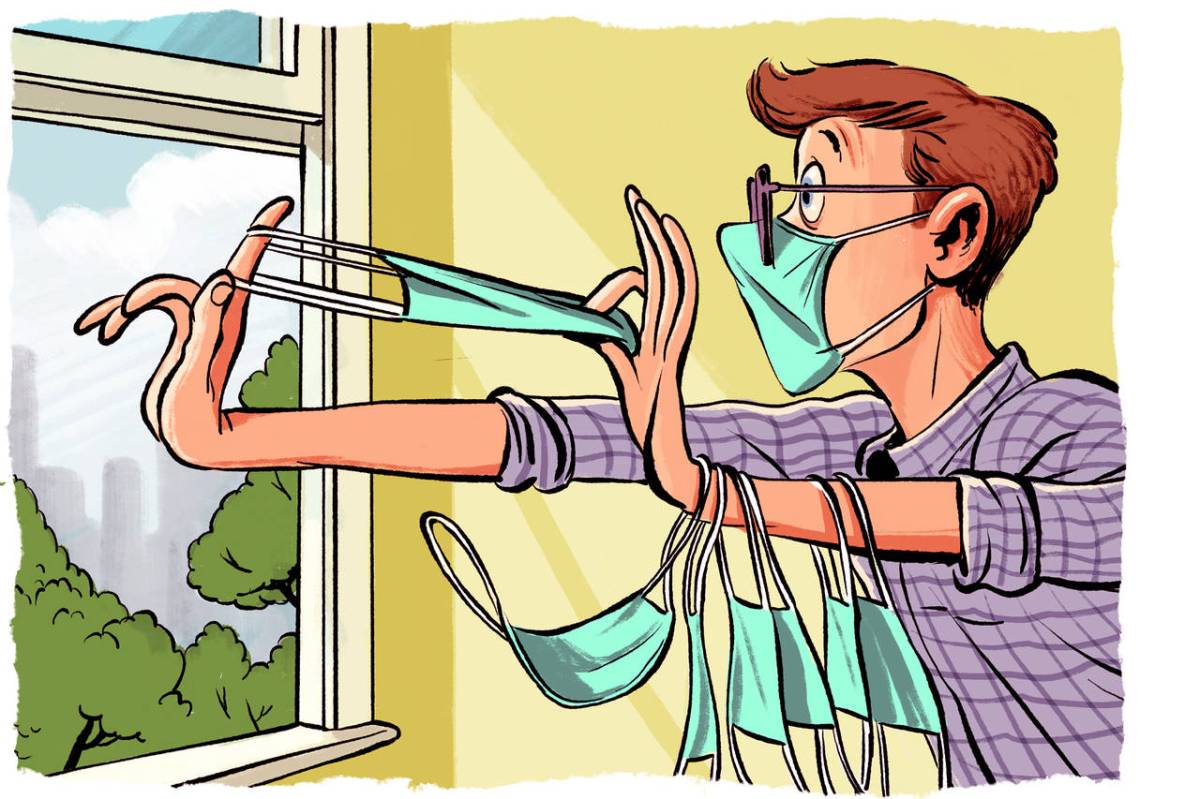
Cover Image Illustrated by Zohar Lazar for the Wall Street Journal
As I write this, the case-fatality rate for COVID-19 in the United States, based on data from John Hopkins University, is 3.1%. I am aware some people may point to other underlying conditions that could have led to such deaths. However, a death is a death regardless of whether it was due purely to COVID-19 symptoms or a case of COVID-19 symptoms exacerbating a pre-existing condition.
To look at moral dilemmas in consequential terms is to ignore the intent of an action and evaluate its morality only on its outcome or consequence. Under such terms, there aren’t any good-faith arguments against wearing a mask while in public places.
In the United States, wearing a face mask to protect the health of others has somehow become a culture war issue. It is disheartening to know that we as a country have actively prolonged and worsened the pandemic by not showing common regard to others, but we must now live with the consequences of this.
Now, I understand there are some apprehensions about wearing a mask as it is not something that was standard practice in American society before the pandemic, but let me posit that standard practices no longer apply. Standard practices no longer apply as we are not in a situation of standard living. We are in the middle of a pandemic, a pandemic that doesn’t care who you are or how you might wish the world to be. Given that the coronavirus doesn’t care about how we desire the world to be and is a force that can negatively impact our lives for an increasingly longer time the longer we do not take it seriously, we, as a society, should do our damnedest to live in the world as it is, not the one we desire it to be.
There are several choices to be made and each choice has different ramifications. You, as an individual, and as a member of a greater society that is currently crippled by ineffective behavior concerning the spread of COVID-19, can choose to continue as if the pandemic isn’t a thing that impacts our lives, which will likely lead to further unnecessary death and economic hardship. On the other hand, you can choose to recognize the necessity of some activities, but that we also exist in an environment directly in conflict with the sustainability of said activities. Therefore, we must wear some protective equipment, a mask, to reduce our chance of contracting or spreading COVID-19 to help enable these necessary activities.
Let’s assert for a second that the only purpose of wearing a facemask is to protect the wearer from contracting COVID-19 and that it has no reduction in the likelihood of spread. In a situation such as this it might be reasonable to not wear a mask, but why one would actively allow themselves to be at greater harm than necessary to a potentially life-threatening virus is beyond me. It makes as little sense as it would for a BMX rider who is contractually obligated to perform all of his dangerous stunts on a hostile track opting not to wear any protective gear.
In reality, the mask, in addition to partially protecting the wearer from contracting COVID-19, also reduces their likelihood of spreading it as well, so the previous BMX analogy doesn’t accurately frame the situation. A more apt comparison is that of a drunk driver, who by getting behind the wheel increases the likelihood of his/her death and increases the likelihood his/her driving will lead to the death of another person. In consequentialist terms, this is not much different than opting to not wear a mask, for both increase the likelihood of death for all parties involved.
Now, I understand that if we are to reduce the above analogy’s argument to its most base level we could arrive at some bizarre conclusions. If we can’t perform any action that increases the likelihood of suffering for another person, then it is impossible to exist, for almost any action has the potential to do so. However, fear not, for moral principles are always hard to completely actualize in all given moments, but they should still serve as north stars for action. To wear a mask is to actively recognize that there isn’t some hypothetical risk in harming another person, but there is an actual risk, and you can do this with no significant cost to yourself.
If you understood the above assertion and still believe you should not have to wear a mask due to perceived infringements on your liberties, real or not, I ask you, “What is more important, your temporary comfort and satisfaction due to not wearing a mask or the health/life of another person/the economy of the nation that impacts all of us?”. If your answer to that question is the former, then I ask you to reflect on what that means about you. If your answer to the question is the latter, however, and you still have concerns about the possible issues relating to liberty, let’s explore that.
To explore whether or not being required to wear a facemask is an actual, legitimate, infringement on liberty or an unwarranted assault on the liberty of the people, It would be helpful to think of the saying, “the right to swing my fist ends where the other man’s nose begins.” As a society, we have generally agreed with this statement, and it has never been one, at least to my knowledge, that has inflamed a culture war within this country. However, the same concept applies to wearing a mask; your right not to wear a mask ends where another person is, another person, who is just trying to go about their life to the best of their ability without being subjugated to potential infection.
Now, there is a slight difference between the example of swinging around your fists and wearing a face mask. A difference that for the purpose of exploring consequential morals is beside the point, but a difference that should be noted for the sake of honesty. The example with the fists is a restriction of action while the example of the facemask compels action. At the current point, the difference between restriction and compulsion, however, seems rather arbitrary,, for both instances share a common principle: that society at large can and should be able to limit the range of acceptable behavior for how it negatively affects innocent people.
I understand that many people who are against wearing a mask are against it due to a distrust in governmental institutions such as the CDC, and I’m not even going to attempt to change anyone’s opinion on that for it is seemingly a fool’s errand. However,I will ask any one who is of that persuasion to consider the concept of Pascal’s wager: the argument that one should believe in God because the cost of doing so is minuscule compared to the reward if God exists and you believe in him. Now, there are some issues with that argument in that application, for it is unclear how to decide which God one should align themselves with, etc. However, when we apply this logic to facemasks and COVID-19 no issues make themselves apparent. To take the logic of Pascal’s Wager and apply it to COVID-19, one should wear a mask for the cost is insignificant, temporary, personal discomfort, and the benefits are lessening the spread of an infectious disease and reducing the amount of time it is necessary to wear a mask.
If you desire to not wear a mask, you should wear a mask to decrease the amount of time you will have to wear a mask. To forgo a mask while desiring not to wear a mask is to only be concerned with one’s self and to take an action that will prolong the economic hardships for everyone. Please think about how the actions you take have ripple effects and that if you opt to not wear a mask, your decision to do so does not exist in a vacuum.
 E. Aaron Baughman's Eclectic Mess