The Consequential Morals of the Mask

To look at moral dilemmas in consequential terms is to ignore the intent of an action and evaluate its morality only on its outcome or consequence. Under such terms, there aren’t any good-faith arguments against wearing a mask while in public places.

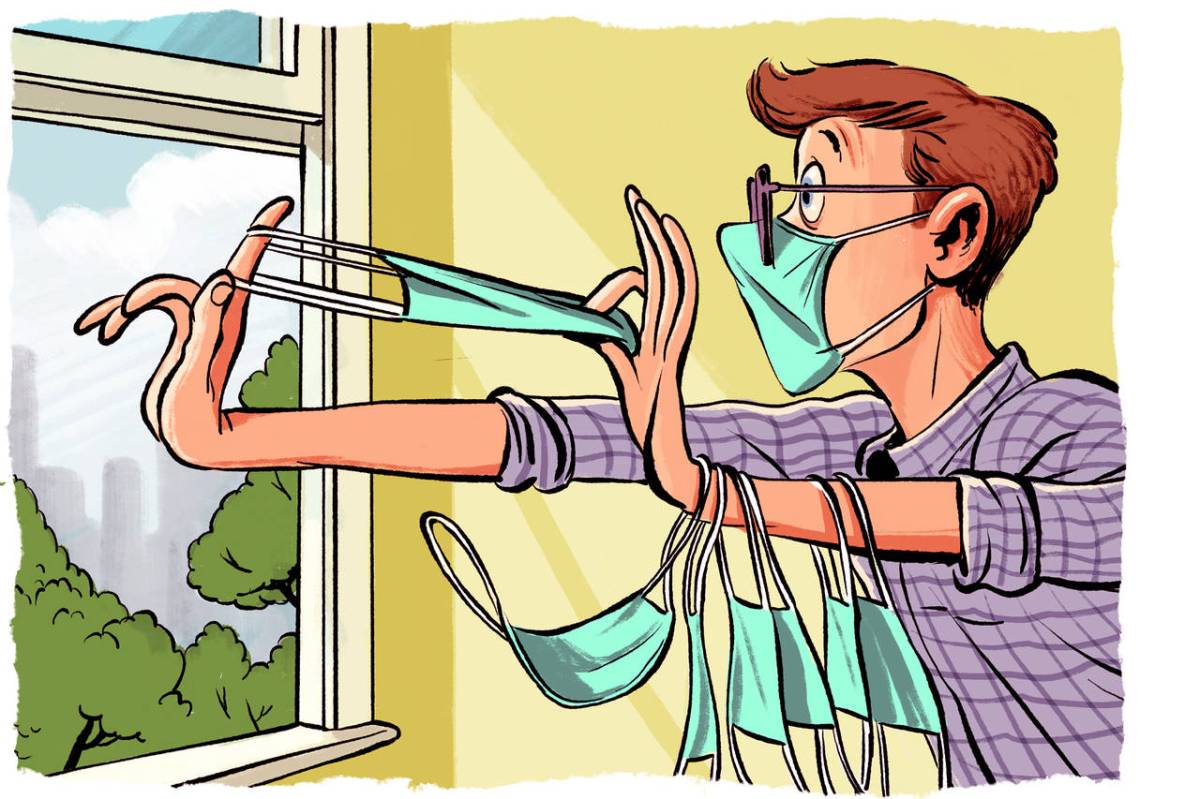
Cover Image Illustrated by Zohar Lazar for the Wall Street Journal

As I write this, the case-fatality rate for COVID-19 in the United States, based on data from John Hopkins University, is 3.1%. I am aware some people may point to other underlying conditions that could have led to such deaths. However, a death is a death regardless of whether it was due purely to COVID-19 symptoms or a case of COVID-19 symptoms exacerbating a pre-existing condition.

To look at moral dilemmas in consequential terms is to ignore the intent of an action and evaluate its morality only on its outcome or consequence. Under such terms, there aren’t any good-faith arguments against wearing a mask while in public places.

In the United States, wearing a face mask to protect the health of others has somehow become a culture war issue. It is disheartening to know that we as a country have actively prolonged and worsened the pandemic by not showing common regard to others, but we must now live with the consequences of this.

Now, I understand there are some apprehensions about wearing a mask as it is not something that was standard practice in American society before the pandemic, but let me posit that standard practices no longer apply. Standard practices no longer apply as we are not in a situation of standard living. We are in the middle of a pandemic, a pandemic that doesn’t care who you are or how you might wish the world to be. Given that the coronavirus doesn’t care about how we desire the world to be and is a force that can negatively impact our lives for an increasingly longer time the longer we do not take it seriously, we, as a society, should do our damnedest to live in the world as it is, not the one we desire it to be.

There are several choices to be made and each choice has different ramifications. You, as an individual, and as a member of a greater society that is currently crippled by ineffective behavior concerning the spread of COVID-19, can choose to continue as if the pandemic isn’t a thing that impacts our lives, which will likely lead to further unnecessary death and economic hardship. On the other hand, you can choose to recognize the necessity of some activities, but that we also exist in an environment directly in conflict with the sustainability of said activities. Therefore, we must wear some protective equipment, a mask, to reduce our chance of contracting or spreading COVID-19 to help enable these necessary activities.

Let’s assert for a second that the only purpose of wearing a facemask is to protect the wearer from contracting COVID-19 and that it has no reduction in the likelihood of spread. In a situation such as this it might be reasonable to not wear a mask, but why one would actively allow themselves to be at greater harm than necessary to a potentially life-threatening virus is beyond me. It makes as little sense as it would for a BMX rider who is contractually obligated to perform all of his dangerous stunts on a hostile track opting not to wear any protective gear.

In reality, the mask, in addition to partially protecting the wearer from contracting COVID-19, also reduces their likelihood of spreading it as well, so the previous BMX analogy doesn’t accurately frame the situation. A more apt comparison is that of a drunk driver, who by getting behind the wheel increases the likelihood of his/her death and increases the likelihood his/her driving will lead to the death of another person. In consequentialist terms, this is not much different than opting to not wear a mask, for both increase the likelihood of death for all parties involved.

Now, I understand that if we are to reduce the above analogy’s argument to its most base level we could arrive at some bizarre conclusions. If we can’t perform any action that increases the likelihood of suffering for another person, then it is impossible to exist, for almost any action has the potential to do so. However, fear not, for moral principles are always hard to completely actualize in all given moments, but they should still serve as north stars for action. To wear a mask is to actively recognize that there isn’t some hypothetical risk in harming another person, but there is an actual risk, and you can do this with no significant cost to yourself.

If you understood the above assertion and still believe you should not have to wear a mask due to perceived infringements on your liberties, real or not, I ask you, “What is more important, your temporary comfort and satisfaction due to not wearing a mask or the health/life of another person/the economy of the nation that impacts all of us?”. If your answer to that question is the former, then I ask you to reflect on what that means about you. If your answer to the question is the latter, however, and you still have concerns about the possible issues relating to liberty, let’s explore that.

To explore whether or not being required to wear a facemask is an actual, legitimate, infringement on liberty or an unwarranted assault on the liberty of the people, It would be helpful to think of the saying, “the right to swing my fist ends where the other man’s nose begins.” As a society, we have generally agreed with this statement, and it has never been one, at least to my knowledge, that has inflamed a culture war within this country. However, the same concept applies to wearing a mask; your right not to wear a mask ends where another person is, another person, who is just trying to go about their life to the best of their ability without being subjugated to potential infection.

Now, there is a slight difference between the example of swinging around your fists and wearing a face mask. A difference that for the purpose of exploring consequential morals is beside the point, but a difference that should be noted for the sake of honesty. The example with the fists is a restriction of action while the example of the facemask compels action. At the current point, the difference between restriction and compulsion, however, seems rather arbitrary,, for both instances share a common principle: that society at large can and should be able to limit the range of acceptable behavior for how it negatively affects innocent people.

I understand that many people who are against wearing a mask are against it due to a distrust in governmental institutions such as the CDC, and I’m not even going to attempt to change anyone’s opinion on that for it is seemingly a fool’s errand. However,I will ask any one who is of that persuasion to consider the concept of Pascal’s wager: the argument that one should believe in God because the cost of doing so is minuscule compared to the reward if God exists and you believe in him. Now, there are some issues with that argument in that application, for it is unclear how to decide which God one should align themselves with, etc. However, when we apply this logic to facemasks and COVID-19 no issues make themselves apparent. To take the logic of Pascal’s Wager and apply it to COVID-19, one should wear a mask for the cost is insignificant, temporary, personal discomfort, and the benefits are lessening the spread of an infectious disease and reducing the amount of time it is necessary to wear a mask.

If you desire to not wear a mask, you should wear a mask to decrease the amount of time you will have to wear a mask. To forgo a mask while desiring not to wear a mask is to only be concerned with one’s self and to take an action that will prolong the economic hardships for everyone. Please think about how the actions you take have ripple effects and that if you opt to not wear a mask, your decision to do so does not exist in a vacuum.

Coffee at 12:39 AM

Pouring the nectar into the jar.
The reason I am still awake pours into my car.

Drip, drip, drip.

John Maynard Keynes enters my brain.
I wait to drain the rain.
The rain, the cause of this pain.
A pain that serves no gain.

Drip, drip, drip.

The nectar, this coffee, not consumed for joy.
Consumed as a tool.
The boy reduced to a fool.

Drip, drip, drip.

I drain the rain, emboldened.
Slitting the tiles, some molded.

Drip, drip, drip.

Now it is time to vacuum the zoom-zoom.
It’s now 3 AM, I will not wake up for the zoom.

America, A Hopeful Lamentation

To ask of her more
Likened to calling her a whore
By those some deplore.
But hey, go divide us more at Mt. Rushmore.

Is this a nation
or merely an imitation
fueled by a blinding culture war
that prevents us from more?


The individual stripping the individual.
A more perfect union.
An idea of perpetual betterment.
Hindered by collective resentment.

An idea not met.
The battle is not over yet.
Self-evident, but not wholly present.
Is the future merely the continued present?

Liberty, but to what end?
Oh, please tell me, my friend.
Posit that it is positive.
Please do not test positive.
Just due to one who posited it as negative.
Refusing to mask it
Complicit with the caskets.

If it is destructive, we must alter.
Being wary not to return the same to the altar.

A government of, by, and, for.
To serve, not be served.
Do not be reserved.
Voice your issue.
We shall not eschew.

The idea to write this came while listening to this song. I highly recommend giving it a listen.

LaCroix at 1 AM, a Haiku

I crack it open.
Razz-crannberry LaCroix can.
I take a few sips.

I hear it bubbling.
It has been thirty minutes.
Pleasant background noise.

But then I finish it.
Gone are the bubbling bubbles.
Just an empty can.

Don’t read into this
It is just about La Croix.
Drank at 1 AM.

Or give it meaning.
That is all up to you, dawg.
This is the end, bye.

Sing Into My Mouth

NOTE: This is heavily inspired by Talking Heads’ This Must Be the Place (Naive Melody)

Choose a song, whatever it may be.
It will be fine with me, but you better know it.
Know it by heart.
Not as a performance of art.
I cannot take anything less.

If it is earnest, I will let you call me Ernest.
Sing into my mouth.
Do not stop to think, just sing.
Get lost in it, the less we say the better.
Let it resonate.

I am your microphone and speaker.
I will do my best to not give feedback.
Just taking it in, however it comes.
Just this I ask of you, give it the same way.
This is how I will know I have been domesticated.

Whatever song it may be, I know this must be the place.

Don’t Let Your Smile Become a Smirk

“There is a time in your life when smile becomes smirk.”

Slaughter Beach, Dog, “Mallrat Semi-annual”

A smile, a ray of joy caught up in the moment, pure, sincere, a universal sign of happiness.

A smirk, a beam of irony that “sees through” the moment, smug, sarcastic, the tool of the self-absorbed.

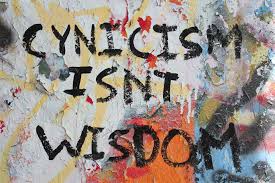
To let one’s smile become a smirk is to embrace the false wisdom of cynicism, seeing through all that one believes has failed them as a coping mechanism of sorts. A coping mechanism meant to inoculate one’s self from the fray of life which can be written off as beneath one’s self when convenient. This, in essence, is not a terrible thing, but it can become a terrible thing because it’s easy. It’s easy to tell one’s self that when something doesn’t go your way, it doesn’t matter because it was meaningless anyway. Once this action becomes habitual, there exists no possibility for growth in the individual, for growth occurs when one confronts that which one fears and conquers it. This is the state of the cynic, delighting in “seeing through” everything and smugly smirking.

The cynic, however, is not doing himself any favors by trying to transcend sentiment out of fear of being human. The cynic’s ironic smirk exists as a cheap-version of the sincere person’s smile. The sincere person can recognize that not all things will go their way and this presents opportunities for growth, and by not attempting to to “see-through” any potential failures or shortcomings as devoid of meaning to save one’s self-esteem and not make one responsible, the sincere person can struggle and then overcome. The sincere person by not “seeing through” things can see that there is meaning to all the failures and shortcomings along the way to the goal, which can make the failures and shortcomings tolerable, and sometimes appreciated. The resigned cynic has no meaning to grasp on to, for as noted by C.S. Lewis “to ‘see-through’ all things is the same as not to see”, and when you’re staring into an abyss there is nothing to latch onto.

Rather than embracing the easy way out which leaves one devoid of meaning, it seems necessary to have a dogmatic belief in the value of sincerity.

Don’t let your smile become a smirk, and remember that sincerity is always in season.

To Penny of Pennsylvania

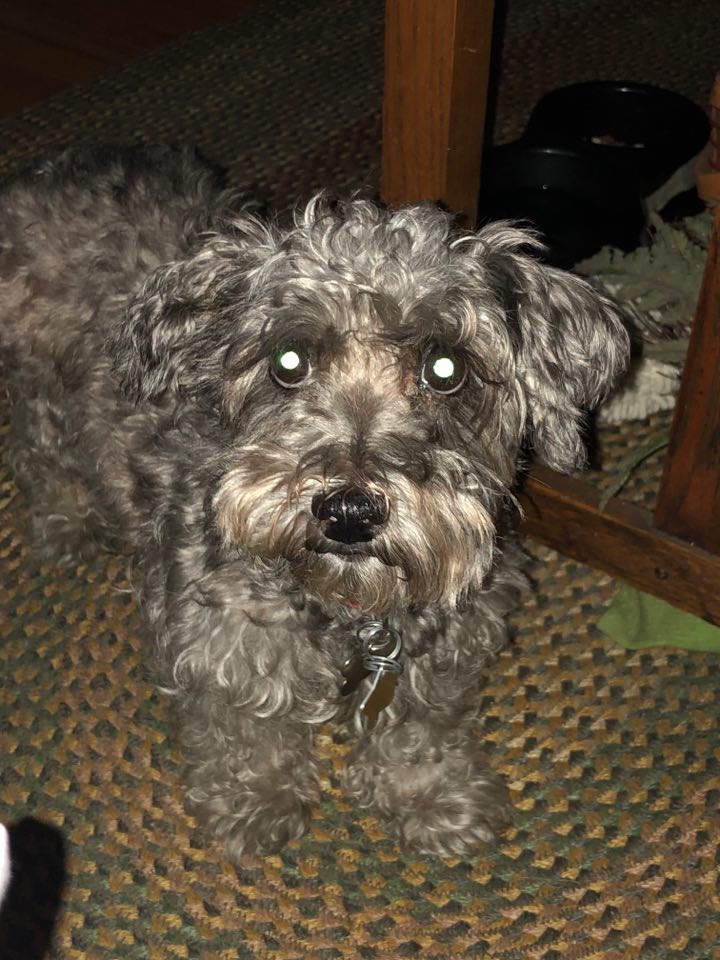
You were chosen because you were a runt.
One could say you died because you were a runt.
Only one kidney to keep you alive.
To get you home was quite the drive.
On my lap you did sit, now you have sunken into a pit.
Wiry black hair I would pet without a care.
Small as could be but big in heart.
You barked at the doorbell as if it were an art.
In your final days beneath the grandfather clock.
You lie there in shock.
Your clock ticking down as you drown.
When you first got home I played with you in the den.
You were rarely put in a pen.
Before you left I played with you as you felt so blue.

Parkway

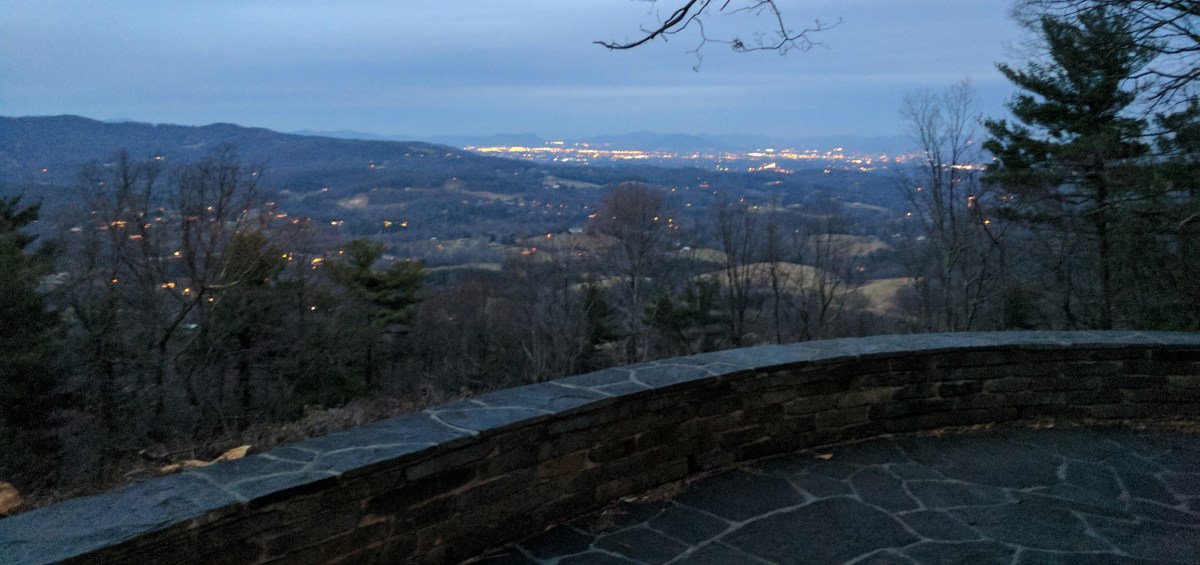
The parkway, a place of solitude, where budding thoughts begin to bloom.
The tress on opposing sides appear so far.
As I near, they begin to part the sea seemingly just for me.
The stone bridge I drive beneath makes me feel complete.
Windows down as I leave town.
There is folk in the air, and wind in my hair.
Windows down as I leave town.
The road ahead is all I can see and all there ever will be.
Nothing can stop me.

Summer Staff: a Time of Service, Growth, and Friendship

Matthew 6:33: “But seek first the kingdom of God and his righteousness, and all these things will be added to you.”

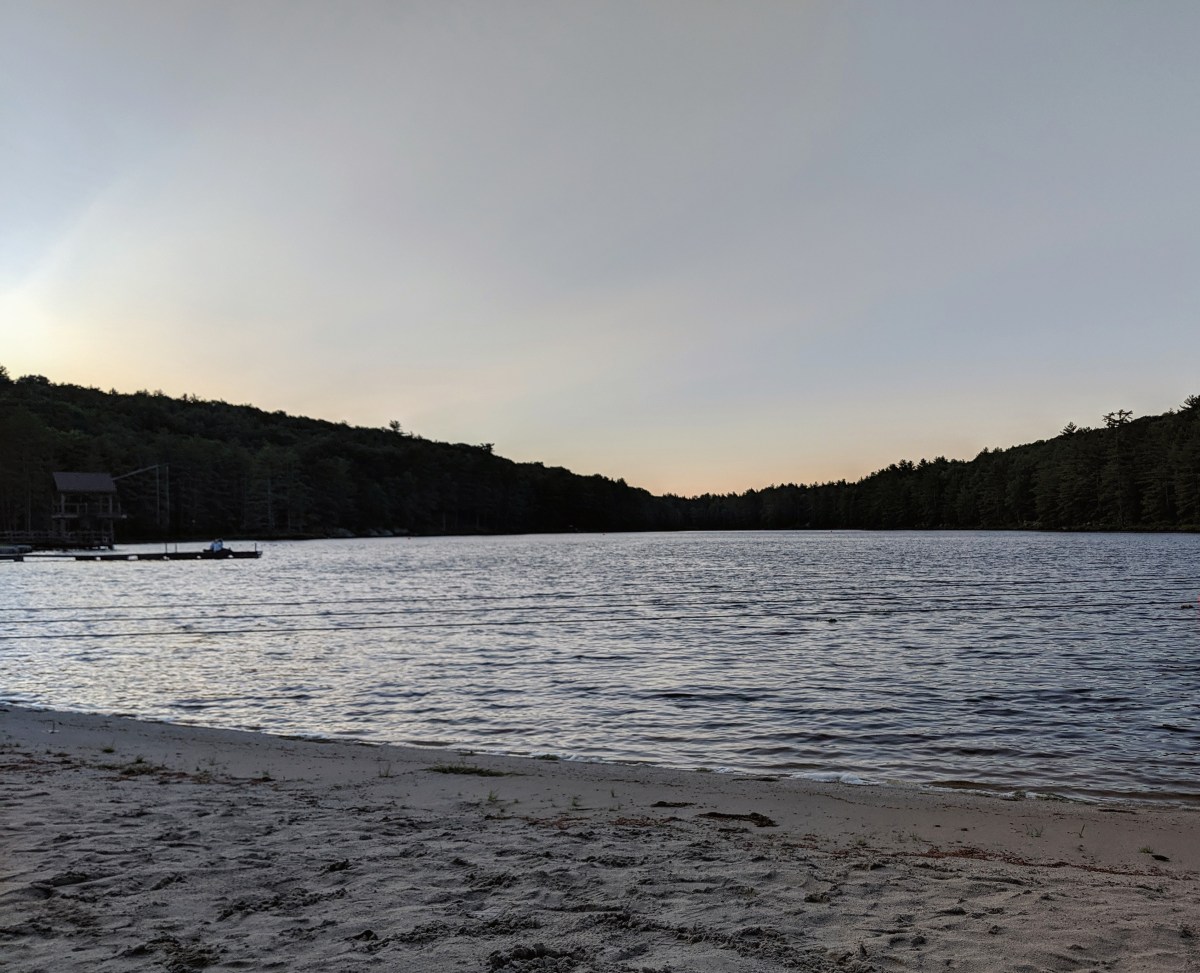
For the month of June, I was blessed with the opportunity to serve as a mountain bike instructor and become a “Certified Bike Wrangler” — a title I will bring up whenever the opportunity presents itself — at YoungLife’s Lake Champion which is located in the ever-interesting rural part of New York that is less than an hour out of Pennsylvania.

Throughout the month and even before my arrival I was presented with opportunities for growth, some of which I probably squandered without even being aware of it. It didn’t really sink in with me that I’d be leaving home to drive 8 hours and give up a month of my Summer until roughly a week before, at which point I began to apprehensively pack my bags. I also had to make a plan for how I would get there by noon of May 31st: take a nap around 6 pm the day before on my couch and fall asleep to The Grand Budapest Hotel, wake up around 11 pm to catch the end of Game 1 of the NBA Finals and pack my car, then leave my house around midnight with coffee in hand and 11 hour playlist queued up for the 8 hour drive as I knew at one point I would go on a skipping spree where I would search for a specific song but have no idea what the song I was looking for was until I found it.

Driving on the interstate when it’s just one’s self and tractor trailers is bliss.

Around 5 am or so I am driving through Pennsylvania, the sun is attempting to rear its head through the fog with little success, and I am belting out the words, “I need you so much closer”, from Death Cab for Cutie’s Transatlancism as if it was the only ever sentence I had ever uttered.

The stage of driving where you have to entertain yourself, for the driving has become purely mechanical, not mental reduces me to acting like a child in the best ways possible.

Just before 8 am, I make it on the campgrounds, begin to unpack, and do any last-minute things on my phone that come to mind as I will be turning my phone in to be held under lock and key at brunch which is at 10:30 am as I found out from a whiteboard I walked by in Fox Run, the building that served as home while at Lake Champion.

The first day continues to roll on and Max, the master of the “Summit Mountain Bikes” shack, Zach, my fellow “Certified Bike Wrangler, and I hit the bike trail. I am riding a bike named Beemer which I eventually renamed to Santiago. The trail destroys me, my glutes are wrecked, my lips are shedding, and I think to myself what I have signed up for.

The following day, June 1st, campers arrive. Max, Zach, and I make 500 water balloons for festivities that I will consciously not detail here because if someone who has never been to a YoungLife camp before somehow stumbles upon this I would hate to ruin any surprises that await them. Filling water balloons became something we got quite efficient at, for we filled water balloons on the first and third day of every week, and the tedium of the job allowed for conversation. By the end of the day, we rode around again. This time Max, Zach, and I were accompanied by yet another Max (there were at least 3 guys named Max there to my knowledge), who gave me some pointers which made riding less grueling and much more pleasurable.

As the days went on, the work became more like second nature than conscious effort. I had begun to get comfortable, which is when I believe it is easiest to make bone-headed mistakes or oversights. A pattern in my prayer for the month after the job became rote was to avoid getting comfortable. This was quickly answered by the 4th week of camp when Max, the bike shack commander, and it was up to Zach and me to keep the bike shack which was located next t0 the ropes course from burning down.

Until the 4th week of camp, there were minimal issues that needed to be addressed with bikes. During the last week at camp a chain broke mid-ride, a plastic guard on one of the rear-tires got damaged and warped, and on the last ride of the month, a tire popped during a ride.

The chain presumably broke due to the camper riding the bike not listening to our instructions and shifting gears while not pedaling. I swapped bikes with him and walked the bike he was on through the trail back to the shack and tried to remember how Max showed me to fix this. Fixing a bike chain isn’t hard, but it’s not simple. After 30 minutes or so of frustration and getting closer and closer to fixing it the correct way, I finally got it.

Before Max had to leave in the last week we wrote our name on the wall of the bike shack as well as our favorite bible verse which is not permitted in the ropes shack because ropes are inferior to bikes. I wrote Matthew 6:34: “Therefore do not be anxious about tomorrow, for tomorrow will be anxious for itself. Sufficient for the day is its own trouble.”

The day after Max left he left Zach and me a thoughtful note as well as a verse for each of us to meditate on. He left me Matthew 6:33: “But seek first the kingdom of God and his righteousness, and all these things will be added to you.” As someone who always asks or wonders why things are the way they are, it quickly hit me that verse 34 means absolutely nothing without the advice of verse 33 that enables one to take the advice in 34.

As the days at camp blended into one, I came to know the ~40 other Summer Staffers quite well. Those in Room 3, my room, I came to know the closest for obvious reasons. Room 3 played host to some thoughtful conversation, absurd jokes, the kind of collective complaining that fosters camaraderie, interesting bouts of sleep talking that entertained everyone who was still awake, and poor renditions of early 2000’s pop-punk songs.

Regards to Fellow Summer Staff:

  • To Laundry: I don’t know how the tedium of folding clothes for hours on end didn’t drain you mentally. Thank you.
  • To Maintenance & Landscaping: It seemed as if you were always busy and on the go. Thanks for keeping camp functional and beautiful.
  • To Cooks: Thank you so much for getting up early so that there would be breakfast to eat. Without you, we would have starved.
  • To Waterfront: Thank you for mingling with everyone when it would have been easy to insulate yourselves.
  • To Retail: Thank you for putting up with late hours and monotonous work.
  • To Program Techs: You guys were so behind the scenes that I neglected to write you in here initially. However, that seems fitting because you guys did a lot of work without a lot of recognition for it. Thank you.
  • To Ropes: Thanks for snapping campers into carabiners so they don’t get injured. Remember this, bikes are better than ropes.

Five Tips to Improve Your Essays Immediately

You need to find some incriminating dirt about your professor to hold onto throughout the semester.

I just finished my first year of college, and I had to write a few papers which all turned out pretty well. So, I thought I would share some pro tips and tricks for how to crush any essays you ever have to write.

The quality of your paper has nothing to do with the arguments and perspectives you put forward. All that matters is that your paper has the style of presentation which makes it seem like you know what you are talking about.

  • Tip 1: Make Your Topic Clear

You do not want your reader to be confused as to what your paper is about. To make sure this doesn’t happen, you should have within the first paragraph of your paper a sentence that says “This paper will be about…”. This makes it clear what your paper is about so the reader can not misinterpret it.

  • Tip 2: Make It Clear Who Wrote Your Paper

You might think that putting your name at the top of the essay, would make it clear that it was written by you. However, it is better to play it safe and make it clear. If you make it clear that the paper was written by you, you can avoid any charges of plagiarism being thrown at you.

Example Sentence: “I, myself, Aaron Baughman, hold in my mind the belief that peak sausage is better than peak bacon.

  • Tip 3: Make The Scope of Your Topic Abundantly Clear

You might think that the substance of your paper would make the scope of your topic clear, but remember substance is not what matters. What matters is having presentation that makes it seem like there is substance! To make the scope clear, you should put in your intro paragraph something along the lines of: “Throughout history…”, “Many people hold opinions on…”, or “[Insert Topic Here] is the most important thing in the world as noted by important people”.

  • Tip 4: Do Not Be Confident

This is where presentation is really important! Instead of saying something assertive, such as, “the sky is blue”, you’re going to want to say something more along the lines of “the sky might be blue” because nothing can be known for sure. If you use qualifying statements for everything, you can never be wrong.

Make sure to use the Socrates quote: “True knowledge exists in that you know nothing.” Also, if your professor challenges you on this, point them to the aptly placed Socrates quote in your paper. If they challenge you on not being assertive, they are challenging Socrates, which you could use to publicly shame them (I’ve heard blackmail is an effective way to crush any essay).

  • Tip 5: Blackmail

Okay, this tip has nothing to do with your paper’s presentation or substance, and I have never personally tested it, so do not hold me accountable on this one. You need to find some incriminating dirt about your professor to hold onto throughout the semester. Do not make it obvious that you have this information, but make allusions to it throughout class discussion and any emails you have with your professor. They will probably pick up on what you’re putting down and be afraid to give you anything less than a B.